

USDT Betting: Tether Sports Betting Networks, Fees & Steps
With Tether sports betting, the bankroll is USDT, a stablecoin pegged 1:1 to the US dollar: you deposit it to a sportsbook account over a blockchain network such as TRC-20, ERC-20, or BEP-20, wager from that balance, and withdraw winnings to your own wallet on a matching network. The coin is the easy part. The network you pick decides what the deposit really costs.
Most USDT betting guides still get that part wrong. They repeat that TRC-20 costs "fractions of a cent" and ERC-20 close to $20. Our own measurements of live USDT transfers say otherwise, and the real figures are below.
USDT quick facts
- USDT networks in the cashier: 9 (ERC-20, TRC-20, BNB Chain (BEP-20), Polygon, Avalanche, Optimism, Arbitrum, TON, Solana)
- Deposit and withdrawal minimum: 1 USDT each
- Our withdrawal fee: 0.5 USDT on BNB Chain (BEP-20), other networks show theirs before you confirm
- Cost to send one USDT transfer (our sample): BEP-20 about $0.0025, ERC-20 about $0.17, TRC-20 from $0 to $4.33
- Stakes: priced in US dollars, from $0.11 per bet
- Price of 1 USDT: about $1, the level the peg is built to hold
Want to test the process with a few dollars first? Open a free account, go to the cashier, and pick USDT.
What is Tether (USDT)?
Tether (USDT) is a US dollar stablecoin first issued in October 2014. With roughly 184 billion tokens in circulation at the time of writing, it ranks third by market cap among all crypto assets and holds 59.9% of the whole dollar stablecoin market, compared with 23.7% for USDC. Just over half of the supply lives on Tron (50.6%) and most of the rest on Ethereum (46.9%). Tether publishes quarterly reserve attestations by the accounting firm BDO, and a recent one reported $187.75 billion in assets against $183.64 billion owed to holders, roughly $115 billion of it in US Treasury bills.
Why bet from a dollar bankroll?
A sports bet already carries one unknown: the result. Fund it with bitcoin and you add a second, the coin price, which keeps moving until the final whistle.
Two bettors each deposit $500 before a weekend of NHL games, one in bitcoin, one in USDT. In a quiet month bitcoin's typical daily swing is about 2%, yet on its biggest days it has moved around 15%. A day like that overnight can leave the first bettor with $575 or $425 before a single wager. The second still holds 500 USDT, worth about $500, and knows exactly what the bankroll is.
Our sportsbook prices every stake in US dollars, while your balance stays in the token you deposited: bankroll in the token, stakes in dollars. With ETH or LTC the dollar value of that balance drifts all day. With USDT the two numbers sit almost on top of each other, so a $50 stake draws roughly 50 USDT and a $120 return comes back as roughly 120 USDT.
USDT networks compared: fees, speed, and address formats
All nine USDT networks work for deposits and withdrawals alike, and the USDT networks and minimums also sit on our Tether casino page. Those lists skip the sending cost, so we read it from 25 to 30 real USDT transactions per chain. Figures measured in October 2026; your wallet shows the live fee before you sign.
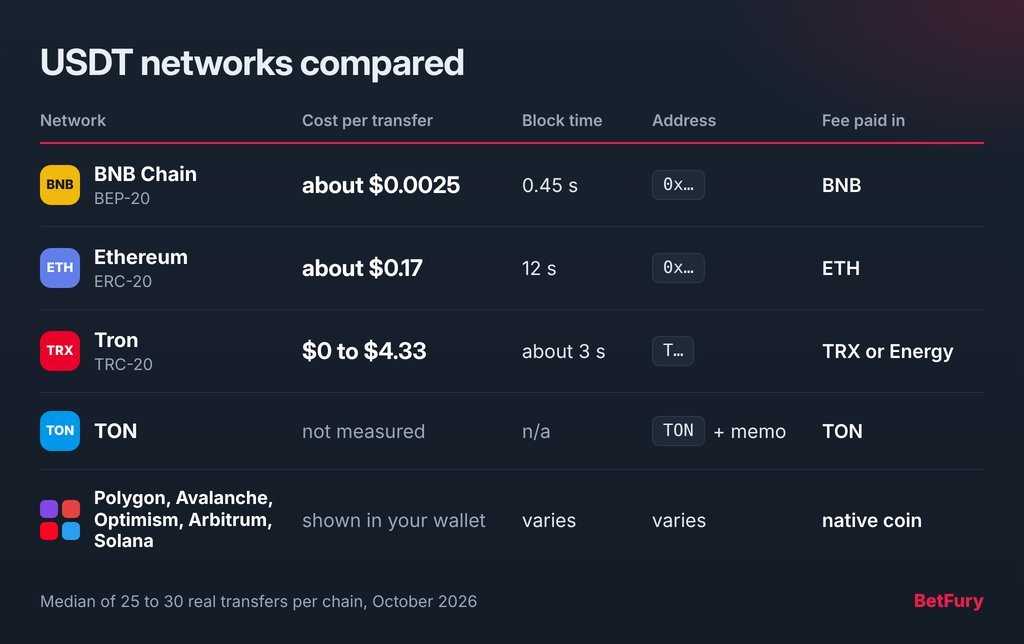
The highest fees in the sample were $0.07 on BEP-20 and $0.34 on ERC-20, and the TRC-20 range depends on Energy (explained below). BEP-20, ERC-20, and most other networks share the 0x format, and TON also needs its memo (comment), so match the exact network name in the cashier and in your wallet.
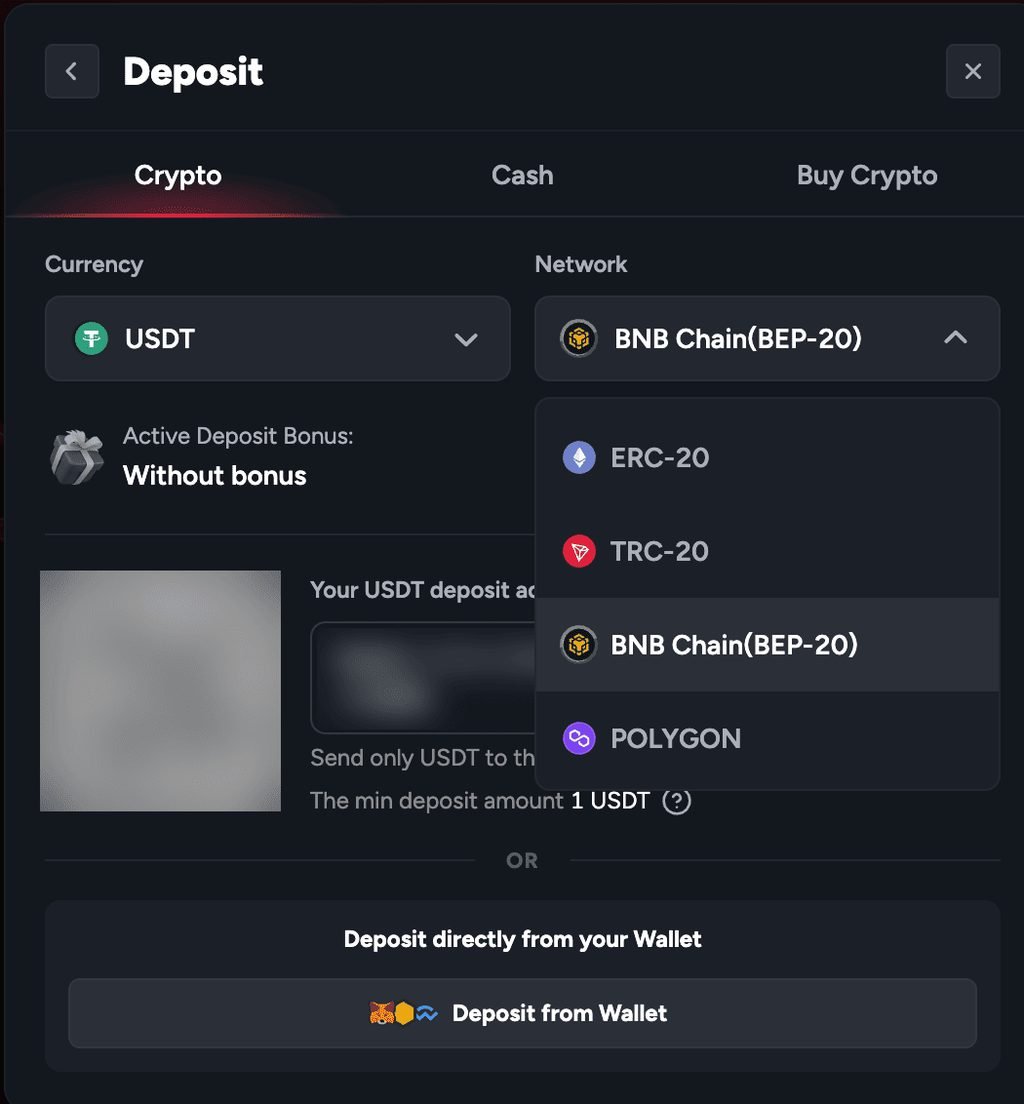
The USDT deposit window lists nine networks. Pick the same one your wallet will send on.
Why TRC-20 stopped being the "pennies" network
Tron has no flat fee for USDT. Each transfer burns a resource called Energy, which you either hold (by staking TRX or renting it) or buy by burning TRX at 100 sun per unit. In our sample, a transfer to an address already holding USDT used 64,285 Energy, and one to an address with a zero USDT balance used 130,285. Without your own Energy that comes to 6.43 TRX or 13.03 TRX, about $2.13 and $4.33 with TRX near $0.33. Bandwidth adds 0.345 TRX (about $0.11) once the 600 free daily points run out.
So why the cheap reputation? Of the 30 transfers we checked, 25 paid nothing for Energy because the sender had staked or rented it. A bettor sending from a fresh wallet with a few TRX pays full price, and if the receiving address holds no USDT, plan for the higher figure. All of this comes after Tron cut the Energy price from 210 to 100 sun on August 29, 2025.
BEP-20 USDT is a Binance token
The USDT on BNB Chain is a bridged token labelled "Binance-Peg BSC-USD", and Tether's transparency data lists zero tokens issued there. It still trades at a dollar, so for Tether betting the only catch is that you can't redeem it directly with Tether.
Which network fits your deposit size?
Flat fees hurt small deposits most. Measured as a share of the deposit, TRC-20 without Energy takes 10.7% of $20, 2.1% of $100, and 0.43% of $500, and about twice that when the receiving address holds no USDT. ERC-20 takes 0.87% of $20, 0.17% of $100, and 0.03% of $500, while BEP-20 stays at 0.01% or less.
A rough rule from those figures:
- Under $100: BEP-20 first, ERC-20 second. A $20 TRC-20 deposit without Energy loses a tenth of the bankroll before the first bet.
- $100 to $500: TRC-20 works if your wallet has staked or rented Energy. Otherwise the other two win.
- Above $500: the gap shrinks to fractions of a percent, so use whichever network your USDT already sits on.
Count the trip out too. On BNB Chain the deposit costs about $0.0025 and our withdrawal fee is 0.5 USDT, so a round trip runs close to 50 cents: 2.5% of a $20 bankroll, 0.1% of $500. Small bankrolls do better cashing out less often, in larger chunks.
Fees move, so check your wallet's estimate (or the Etherscan gas tracker or Tronscan) right before sending.
Depositing USDT in six steps
No USDT yet? The Buy Crypto tab in the cashier sells it for regular money: pay with Visa, Mastercard, Google Pay, Skrill or another local method, and the system picks the cheapest provider available in your country. The purchase goes straight to your balance, and some providers ask for a quick ID check the first time. For a walkthrough, see this guide to buying crypto. The steps below are for coins you already hold.
- Get USDT into a wallet you control. Our help centre suggests sending from a personal wallet, not straight from an exchange. Short on options? Compare these wallets that handle USDT.
- Keep a little of the network's own coin for fees. TRX for TRC-20, ETH for ERC-20, BNB for BEP-20. Without TRX, a TRC-20 transfer won't go out.
- Open the cashier. Of its three tabs (Crypto, Cash, Buy Crypto), you want Crypto. Choose USDT, then the network.
- Copy the address, and the memo on TON. Check the first and last characters after pasting, since clipboard malware swaps addresses. Re-check any old address saved in an exchange's address book too.
- Send a small test first. It has to be at least 1 USDT, because a smaller transfer may never be credited. Once it shows up, send the rest.
- Or skip the copy and paste. "Deposit from wallet" connects MetaMask, Trust Wallet, or WalletConnect, and you approve inside the wallet.
Deposits credit automatically once confirmed. Tron finalizes a block after 19 more (about a minute), BNB Chain in under a second, and Ethereum in about 13 minutes. In rare cases a deposit takes 24 to 72 hours, so top up well before puck drop.
Placing a bet with USDT: worked payouts
Decimal is the default odds display, with American, fractional, Hong Kong, Indonesian, and Malaysian formats in the sportsbook settings. The minimum stake is $0.11. The coupon displays dollars, but with the token sitting within a fraction of a cent of $1, a 100 USDT stake and a $100 stake are practically the same, so the examples use USDT.
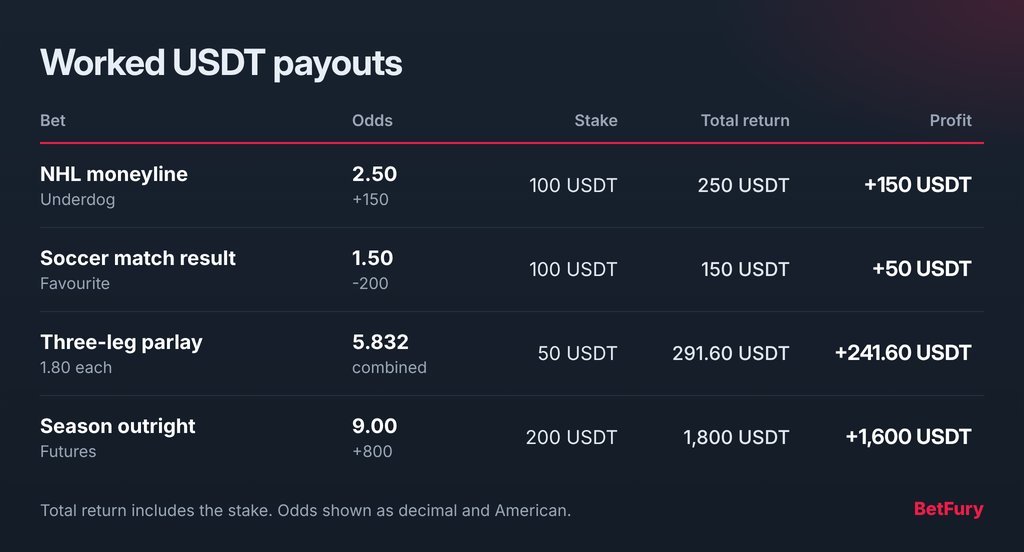
Decimal odds multiply the stake and include it in the return. In American odds, +150 means a 150 profit on a 100 stake, and -200 means risking 200 to win 100. A parlay multiplies its legs: 1.80 × 1.80 × 1.80 = 5.832.
The futures row is where a stablecoin earns its keep. That ticket can sit open for months, and whatever crypto does in the meantime, 1,800 USDT is still about $1,800. Cash Out may be available on pre-match and live bets if you'd rather settle early.
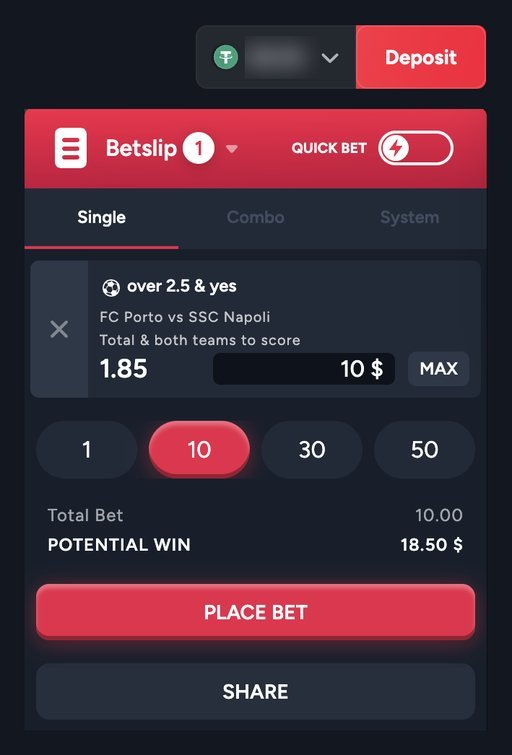
The bet slip prices the stake in dollars and takes it from the USDT balance.
USDT sports betting: what's on the board
Our USDT sportsbook covers 80+ sports, from the NHL, NFL, and CFL to Premier League soccer, tennis, and cricket, live and pre-match. Three quick starts: soccer betting with USDT, hockey betting with Tether, and basketball betting with USDT. Gamers can use the same USDT balance on esports markets for CS2, Dota 2, League of Legends, and Valorant.
Units and ROI stay clean in a stablecoin
Set one unit at 1% to 2% of the bank, so 10 to 20 USDT on 1,000 USDT, and track ROI as profit divided by total staked, times 100.
Forty bets of 25 USDT make 1,000 USDT staked. Finish 60 USDT up and your ROI is 6%. In bitcoin the same ledger blurs: the price moved between the first bet and the last, so you can't tell whether the profit came from your picks or from the coin.
Getting your USDT back out
- Open the wallet, choose Withdraw, and select USDT.
- Pick the network. It doesn't have to match the one you deposited on, so a TRC-20 deposit can come back out on BNB Chain.
- Paste the address or pick a saved one from the address book, then read it against the original once more.
- Enter the amount or press Max, then read the fee line under the button.
- Confirm with 2FA, which every withdrawal requires.
The minimum withdrawal is 1 USDT. The fee is 0.5 USDT on BNB Chain (BEP-20), and other networks show theirs before you confirm, so factor it in. Dust under 1 USDT can't be withdrawn and remains on the account. Under the platform's anti-money-laundering rules, deposited funds may also have to be played through on bets before a payout.
BetFury processes most withdrawal requests within minutes. Larger wins and flagged transactions take longer, and our deposit and withdrawal guide covers the same screens for other coins.
USDT deposit not showing? Check five things
- Network. A transfer sent over ERC-20 while the cashier was set to BEP-20 won't credit. Compare your wallet history with the network picked in the cashier.
- Amount. Anything under 1 USDT falls below the minimum.
- Time. Tron needs a minute or two, Ethereum up to about 13 minutes, rare cases 24 to 72 hours.
- Transaction ID. Paste the TxID into that chain's explorer (Tronscan, Etherscan, or BscScan). It should read "success" and show your deposit address.
- Support. Still missing? Send support the coin, network, deposit address, date, and TxID, plus the memo for TON.
Pros and cons of USDT betting
Pros
- A bankroll that holds its dollar value. 500 USDT on Friday is still about $500 on Monday, whatever bitcoin did over the weekend.
- Nine networks in one cashier. Send from whichever chain your Tether already lives on, with no bridging.
- Pennies on BNB Chain. A transfer there runs roughly $0.0025, and our withdrawal fee on that network is 0.5 USDT.
- A 1 USDT floor. Trying the route with a dollar or two is perfectly normal.
- Season-long tickets keep their worth. A futures payout promised in USDT arrives worth roughly the same in dollars months later.
- Liquid almost anywhere. As the biggest stablecoin, USDT trades on nearly every exchange, so turning winnings into cash is simple.
Cons
- TRC-20 can cost a few dollars from a wallet with no staked or rented Energy. For small deposits, BNB Chain or ERC-20 is the cheaper road.
- Look-alike addresses. BEP-20, ERC-20, and several other networks all use 0x addresses, so pick the same network name in the cashier and in your wallet, and let a 1 USDT test confirm it.
- Small peg wobbles. The peg has held close to $1 almost all the time, with short dips during big market shocks. For sports betting with Tether, where a balance is measured in days, that rarely shows.
- TON needs a memo. Copy the comment along with the address and the deposit credits normally.
Whether crypto betting is allowed depends on local law where you live, and switching coins doesn't change that. BetFury holds a Curaçao Gaming Authority licence (OGL/2024/1494/0942), and KYC isn't needed to sign up but can be requested later. Set a budget before the first deposit, and the deposit limits and self-exclusion tools are there whenever you want a firmer cap.
Ready for a first USDT bet?
There is no sports welcome bonus yet. One is planned soon. Until then, regular bettors collect weekly free bets sized on last week's sports action, and a winning combo can get a ComboBoost of up to 50% on top. New networks keep arriving and the terms keep improving, so check the cashier before you send.
A sensible first move: deposit $20 on BNB Chain, place a few singles at odds you can work out in your head, and open the withdrawal screen once. Ten minutes of that teaches more than any table above.
Other coins for sports betting
Tether is the steady option, but not the only one. If your wallet holds something else, start with our guides to Ethereum betting, Litecoin betting, BNB betting, and Solana betting. Fans of meme coins and payment tokens will find Dogecoin betting and XRP betting covered too, and bitcoin betting works from the same sportsbook.
FAQ
1. Is USDT 100% safe?
Nothing in crypto is risk-free, but USDT has a long track record. Its peg has held close to $1 almost all the time, with short dips during big market shocks, and its reserves are checked in regular attestations (an accountant's snapshot on one date, a lighter check than a full audit). For a betting balance, the steps that matter most are simple: pick the right network, send a small test first, and withdraw to a wallet in your own name.
2. Is USDT real money?
USDT is a crypto token, not legal tender, but it is built to track the US dollar 1:1 and is widely exchanged for cash. 100 USDT normally trades within a few cents of $100. You can sell it for dollars on an exchange or spend it wherever USDT is accepted.
3. Which network is cheapest for a USDT deposit?
In our measurements, BNB Chain (BEP-20) was cheapest at about $0.0025 per transfer, and ERC-20 came second at a median of about $0.17. TRC-20 cost nothing for wallets with staked or rented Energy, but $2.13 to $4.33 without it. For deposits under $100, BEP-20 is the sensible pick.
4. How do I cash out USDT winnings?
Open the wallet, choose Withdraw, select USDT and a network, then paste your address and confirm with 2FA. The minimum is 1 USDT. The fee is 0.5 USDT on BNB Chain, and other networks show theirs before you confirm. Deposited funds may first have to go through bets.
5. What happens if I send USDT on the wrong network?
It won't appear in your balance on its own, and a blockchain transfer can't be pulled back from the sending side. Write to support with the coin, network, address, date, and TxID, and the team will check it. ERC-20 and BEP-20 addresses both start with 0x, so check the network name as well as the address. A small test transfer avoids the whole issue.
6. Is USDT better than USDC for betting?
Both stablecoins track the US dollar, so either keeps a bankroll steady. USDT is far larger, with 59.9% of the dollar stablecoin market against 23.7% for USDC, and our cashier accepts it on nine networks. USDC is issued by Circle. Pick the one your wallet already holds.
7. Can I bet on esports with USDT?
Yes. The same USDT balance works for esports markets, including CS2, Dota 2, League of Legends, and Valorant, both pre-match and live where available. Stakes are priced in dollars from $0.11, and odds can be switched from decimal to American or another format in the sportsbook settings.